Welcome to Visit Dayue Import and Export Guangzhou Co., Ltd.

News
Dayue Import and Export Guangzhou Co., Ltd.
Industrial Sodium Hydroxide Purity Grades and Common Uses
Industrial Sodium Hydroxide Purity Grades and Common Uses
Industrial Sodium Hydroxide is available in several purity grades, each matching different process demands, handling rules, and quality targets.
That matters because grade selection affects reaction efficiency, equipment life, worker safety, and downstream product consistency.
In daily operations, the wrong caustic grade can create hidden costs long before it causes an obvious failure.
This guide explains the main Industrial Sodium Hydroxide purity levels, their impurity profiles, and the applications where each grade makes the most sense.
It also highlights practical checks that support safer storage, stronger compliance, and more reliable material approval decisions.
Why Purity Grade Matters in Industrial Sodium Hydroxide
Industrial Sodium Hydroxide is rarely judged by sodium hydroxide content alone.
Buyers also review sodium carbonate, chlorides, iron, heavy metals, insoluble matter, and trace contaminants from production or packaging.
These impurities can change reaction speed, color stability, scaling tendency, and even filtration performance.
More importantly, they can affect regulatory acceptance when the material is used in sensitive processing environments.
From a safety angle, concentration is just as important as chemical purity.
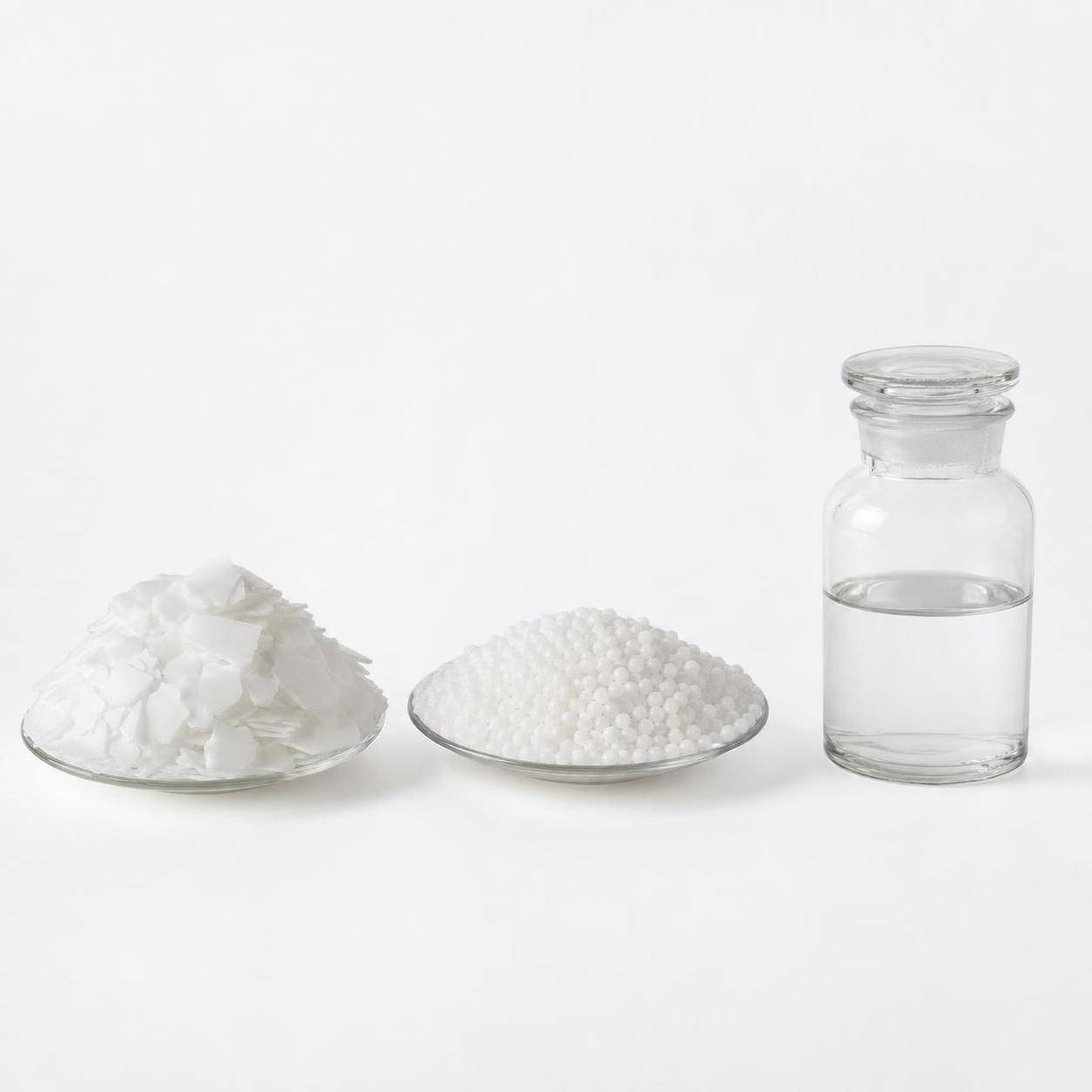
Solid flakes, pearls, and liquid solutions present different spill behavior, heat release, and transfer risks.
So when evaluating Industrial Sodium Hydroxide, purity and form should always be reviewed together.
Common Purity Grades of Industrial Sodium Hydroxide
There is no single global grading system used in every market.
Still, most Industrial Sodium Hydroxide falls into a few practical categories that buyers recognize quickly.
Low to Standard Industrial Grade
This grade often ranges around 96% to 98% for solids, depending on origin and production route.
It is commonly used where trace impurities have limited impact on the final process result.
Examples include neutralization, pH adjustment, general cleaning, ore processing, and some wastewater treatment operations.
High Purity Industrial Grade
High purity Industrial Sodium Hydroxide usually reaches 98% to 99% or higher for solid products.
It offers tighter control on iron, chlorides, and insoluble residues.
This grade is preferred when process consistency, brightness, or catalyst protection matters more.
Membrane Cell Caustic Soda
Many buyers now distinguish material by chlor-alkali technology rather than purity alone.
Membrane cell Industrial Sodium Hydroxide is valued for lower salt contamination and a cleaner impurity profile.
That makes it a stronger fit for applications sensitive to chlorides or metallic carryover.
Liquid Caustic Soda Solutions
Liquid Industrial Sodium Hydroxide is commonly supplied at 32%, 45%, or 50% concentration.
These solutions simplify dosing and reduce dust, but they demand stronger controls for storage temperature and corrosion management.
In many plants, solution purity is reviewed through both assay and trace impurity specifications.
Typical Impurities and Why They Change Performance
Understanding impurity behavior helps teams move beyond simple certificate checking.
It also supports better root-cause analysis when product quality shifts unexpectedly.
In practice, small impurity differences can matter more than a one-point change in assay.
That is especially true in multi-step chemical manufacturing where contaminants accumulate downstream.
Common Uses by Grade
The best grade of Industrial Sodium Hydroxide depends on how tightly the process reacts to contamination, concentration drift, or color change.
Water and Wastewater Treatment
Standard Industrial Sodium Hydroxide is widely used for pH correction, neutralization, and sludge conditioning.
Liquid grades are often preferred because they support metered dosing and lower manual handling exposure.
Pulp, Paper, and Textile Processing
Higher purity Industrial Sodium Hydroxide is often selected for pulping, bleaching support, mercerization, and fiber treatment.
Lower iron and insoluble levels help protect brightness and reduce residue-related defects.
Chemical Manufacturing
Industrial Sodium Hydroxide supports saponification, neutralization, catalyst preparation, and intermediate synthesis.
High purity or membrane cell material is commonly chosen where chloride-sensitive reactions are involved.
Metal Processing and Surface Treatment
Industrial Sodium Hydroxide is used in degreasing, etching, and cleaning steps across metal finishing operations.
Here, concentration control may matter more than ultra-high purity, although chlorides can still affect corrosion outcomes.
Mining and Mineral Processing
Standard grade Industrial Sodium Hydroxide is commonly used to regulate alkalinity and support extraction circuits.
Robust supply reliability and safe bulk handling are usually the main decision factors in this segment.
How to Evaluate Industrial Sodium Hydroxide for Quality Control
A useful review process starts before the first delivery arrives.
Supplier approval should connect specification limits with actual process sensitivity.
A practical checklist includes:
- Verify assay, sodium carbonate, chlorides, iron, and insoluble matter against internal limits.
- Review whether the material comes from membrane cell or another production route.
- Check packaging integrity, moisture protection, and lot traceability.
- Confirm concentration stability for liquid Industrial Sodium Hydroxide during storage.
- Align incoming inspection frequency with process risk, not supplier claims alone.
This approach keeps testing focused and avoids over-controlling low-risk applications.
At the same time, it strengthens control where contamination could trigger expensive rework or shutdowns.
Safety and Handling Considerations by Grade and Form
Every form of Industrial Sodium Hydroxide is strongly corrosive, but exposure routes vary.
Flakes and pearls can create dust during charging or repacking.
Liquid caustic reduces dust, yet splashes and heat generated during dilution become the larger hazards.
Safe use depends on a few non-negotiable controls:
- Use compatible storage materials and inspect tanks, lines, and valves regularly.
- Add Industrial Sodium Hydroxide to water slowly during dilution, never the reverse.
- Maintain eyewash, emergency shower access, and spill response materials near transfer points.
- Separate moisture-sensitive solids from humid areas to limit caking and carbonate formation.
- Review SDS details alongside plant-specific exposure scenarios and training records.
In real operations, safe handling is not separate from quality control. It directly supports consistency and reduces avoidable loss.
Choosing the Right Industrial Sodium Hydroxide Grade
A higher grade is not automatically the better choice.
The right Industrial Sodium Hydroxide grade is the one that meets process needs without creating unnecessary cost or handling burden.
For broad utility systems, standard material may be fully adequate.
For color-sensitive chemistry, chloride-sensitive reactions, or tightly specified outputs, higher purity often pays back quickly.
A reliable decision usually comes from matching impurity limits, delivery form, storage setup, and risk tolerance in one review.
That creates a more stable specification and fewer surprises after scale-up or supplier changes.
If the goal is better compliance, safer handling, and steadier output, start by defining which impurities truly matter in your process, then select Industrial Sodium Hydroxide accordingly.
Navigation
- Industrial Sodium Hydroxide Storage and Handling: Key Quality and Safety Control Points
- Activated Charcoal Mistakes That Reduce Adsorption Performance
- Industrial Sodium Hydroxide Purity Grades and Common Uses
- Sodium Hydroxide Price Factors That Affect Bulk Purchasing
- Sodium Hydroxide Granules vs Flakes: Which Fits Your Process?
- Sodium Cyanide Handling Risks and Storage Best Practices
Contact Us