Welcome to Visit Dayue Import and Export Guangzhou Co., Ltd.

News
Dayue Import and Export Guangzhou Co., Ltd.
Sodium Hydroxide Granules vs Flakes: Which Fits Your Process?
Sodium Hydroxide Granules vs Flakes: Which Fits Your Process?
When selecting caustic soda for industrial handling, form matters more than many teams expect.
The choice between flakes and Sodium Hydroxide Granules influences storage, transfer, dosing, dissolution, and daily operating stability.
On paper, both deliver the same core chemistry.
In practice, particle shape changes how the material behaves across the whole process chain.
That difference becomes critical when consistency, safety, and throughput are under close review.
Flakes are widely used and familiar.
Sodium Hydroxide Granules, however, often provide better control in modern automated or semi-automated systems.
The best option depends on your feed equipment, humidity exposure, solution preparation method, and housekeeping standard.
This guide compares both forms in the areas that usually affect final selection.
What Is the Real Difference Between Flakes and Sodium Hydroxide Granules?
Both products are solid sodium hydroxide with high alkalinity and strong hygroscopic behavior.
The main difference is physical form, not chemical identity.
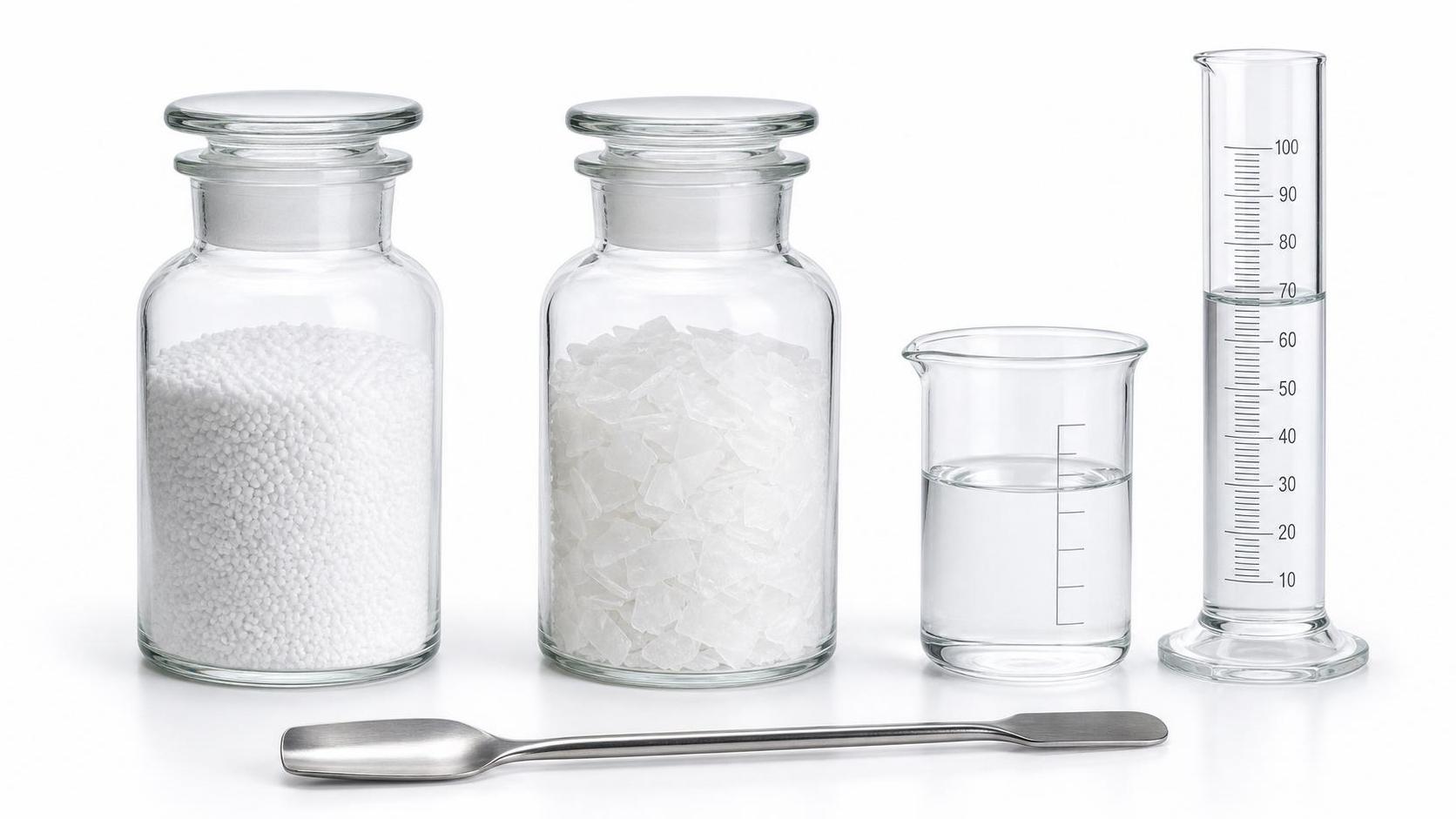
Flakes are thin, irregular pieces.
Sodium Hydroxide Granules are more uniform, denser, and easier to meter in controlled quantities.
That uniformity often improves flow performance in hoppers, screw feeders, and closed transfer systems.
Flakes may bridge more easily when moisture enters storage or when fine fragments accumulate.
This does not make flakes unsuitable.
It simply means their handling profile can be less predictable under some operating conditions.
Why Physical Form Matters in Process Selection
Material form affects more than convenience.
It can influence process uptime, cleaning effort, and the repeatability of every batch.
For example, Sodium Hydroxide Granules usually pour more evenly than flakes.
That supports tighter dosing control in water treatment, detergent blending, textile processing, and chemical manufacturing.
Flakes may still be a practical fit for manual charging or simpler solution preparation lines.
But when feeding precision becomes a key selection factor, granules often move ahead.
- Uniform particles support more stable feeder performance.
- Lower caking tendency helps reduce unplanned stoppages.
- Cleaner transfer can improve housekeeping and operator comfort.
- Predictable dissolution behavior supports consistent solution strength.
Dosing Accuracy: Where Sodium Hydroxide Granules Often Win
If your process depends on exact feed rates, this section deserves close attention.
Sodium Hydroxide Granules are typically better suited to gravimetric and volumetric dosing systems.
Their more regular shape tends to reduce inconsistency during discharge.
Flakes can deliver acceptable results, but they often show greater variability in bulk movement.
That variability matters when small dosage shifts change pH, reaction performance, or downstream product quality.
In continuous production, even modest feed fluctuation can create larger correction cycles later.
This is one reason Sodium Hydroxide Granules are often preferred in automated systems.
Storage and Handling Conditions
Storage conditions can quickly reshape the cost picture.
Both forms absorb moisture and carbon dioxide from air.
That means sealed packaging and dry storage are non-negotiable.
Still, Sodium Hydroxide Granules may offer practical advantages where repeated opening, transfer, or partial consumption occurs.
Their denser form can help reduce loose fragmentation during handling.
Flakes, by contrast, may generate more uneven pieces after transport and repacking.
Over time, that can contribute to caking, bridging, and cleaning burden.
In plants with high humidity exposure, this issue becomes more visible.
Practical storage checklist
- Use moisture-resistant packaging and close containers immediately after use.
- Keep storage zones dry, ventilated, and away from acid materials.
- Review how often operators open bags, drums, or bins.
- Check whether product breakup affects feeder inlets or transfer points.
Dissolution Behavior and Solution Preparation
Many buyers assume thinner flakes always dissolve better.
The real answer depends on agitation, water temperature, charge rate, and tank design.
Flakes can dissolve quickly because of their thin profile.
However, Sodium Hydroxide Granules often dissolve in a more controlled way during measured addition.
That can reduce localized overheating or clumping in systems with disciplined charging procedures.
Because sodium hydroxide dissolution is strongly exothermic, feed control matters as much as particle thickness.
Where operators prepare standard solutions every shift, Sodium Hydroxide Granules can support repeatable concentration targets.
This is especially useful when solution strength directly affects process chemistry.
Safety and Housekeeping Considerations
Safety is never just about PPE.
It is also about how predictably a material moves, pours, and dissolves.
Sodium Hydroxide Granules can help reduce scattered fragments and messy transfer points in some facilities.
That may simplify cleanup and reduce incidental contact risk.
Flakes are still manageable, but they may require more attention where open handling is common.
A cleaner feed area usually supports safer operations and more reliable inventory control.
This also affects audit readiness, especially in tightly managed plants.
When Flakes Make More Sense
Flakes remain a valid choice in many operations.
They can work well where manual charging is established and dosing precision is less demanding.
They may also fit plants already designed around existing flake handling routines.
If storage stays dry and material is consumed quickly, many common flake disadvantages become less significant.
In short, flakes can still be the practical answer when process simplicity outweighs automation goals.
When Sodium Hydroxide Granules Are the Better Fit
Sodium Hydroxide Granules usually stand out in systems built around control and repeatability.
They are often the better fit when your process depends on measured feeding, stable flow, and reduced handling variation.
That includes automated batching, standardized solution preparation, and enclosed transfer operations.
A more obvious signal appears when teams are trying to reduce operator intervention.
In those cases, Sodium Hydroxide Granules can improve consistency without adding process complexity.
Best-fit scenarios for Sodium Hydroxide Granules
- Automated dosing with screw feeders or loss-in-weight systems.
- Frequent solution preparation requiring repeatable concentration.
- Facilities managing humidity-related caking risks.
- Operations focused on cleaner transfer and tighter housekeeping.
A Simple Decision Framework
A useful selection process starts with your equipment, not just unit price.
Ask how the solid caustic is received, stored, conveyed, dissolved, and documented.
Then compare each form against real operating conditions.
- Map each transfer step from packaging to final use.
- Identify where bridging, caking, or feed variation occurs.
- Review whether exact dosing affects product or treatment quality.
- Check if current housekeeping consumes labor or raises safety concerns.
- Test flakes and Sodium Hydroxide Granules under the same controlled conditions.
That side-by-side trial often reveals the best answer faster than theoretical comparisons.
Final Takeaway
There is no universal winner between flakes and Sodium Hydroxide Granules.
The better choice is the one that matches your handling method, control target, and operating environment.
If your process values simple manual use, flakes may be enough.
If your priority is stable feeding, cleaner handling, and repeatable results, Sodium Hydroxide Granules often offer the stronger fit.
The most effective next step is practical evaluation.
Review your current pain points, run a controlled plant trial, and choose the form that improves consistency without creating new handling risk.
Navigation
- Industrial Sodium Hydroxide Storage and Handling: Key Quality and Safety Control Points
- Activated Charcoal Mistakes That Reduce Adsorption Performance
- Industrial Sodium Hydroxide Purity Grades and Common Uses
- Sodium Hydroxide Price Factors That Affect Bulk Purchasing
- Sodium Hydroxide Granules vs Flakes: Which Fits Your Process?
- Sodium Cyanide Handling Risks and Storage Best Practices
Contact Us