Welcome to Visit Dayue Import and Export Guangzhou Co., Ltd.

News
Dayue Import and Export Guangzhou Co., Ltd.
Industrial Sodium Cyanide Uses in Gold Extraction Explained
Why is Industrial Sodium Cyanide so closely linked to gold extraction?
Gold mining discussions often return to one chemical: Industrial Sodium Cyanide. That is not accidental. It remains one of the most effective reagents for dissolving and recovering gold from ore.
In simple terms, this compound helps separate tiny gold particles from surrounding rock. Many deposits contain gold in low concentrations, so recovery depends on a process that is both selective and scalable.
That is where Industrial Sodium Cyanide has industrial value. It supports high recovery rates, works in large processing circuits, and fits established metallurgical methods used across many mining regions.
At the same time, interest in this material is not only about performance. People also want to understand safety, environmental control, cost, and whether alternatives can realistically match its role in gold processing.
What does Industrial Sodium Cyanide actually do inside a gold plant?
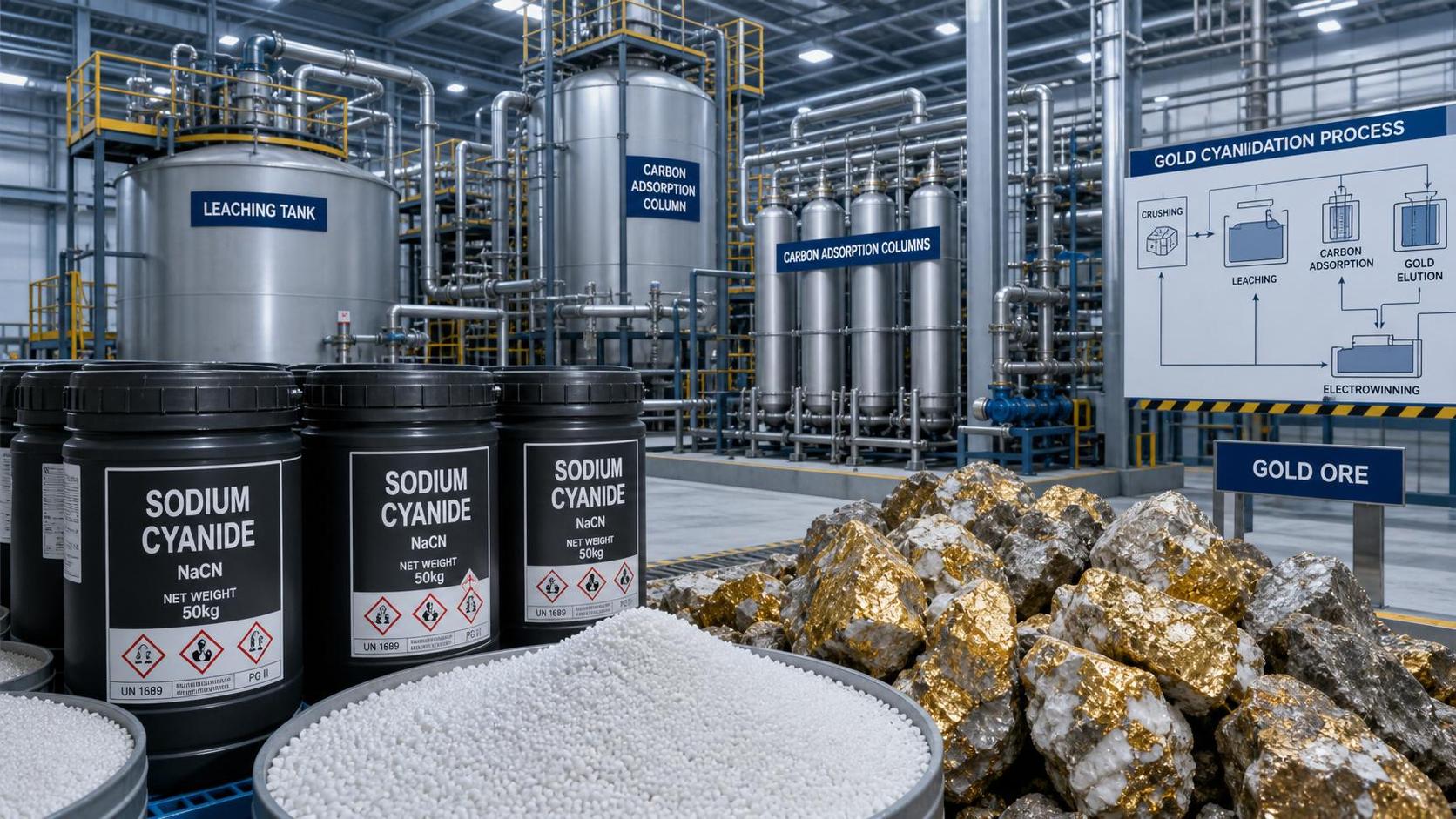
The main job of Industrial Sodium Cyanide is to dissolve gold into a solution so it can be recovered later. This step is known as cyanidation, and it sits at the center of many modern extraction flowsheets.
When ore is crushed and ground, the exposed gold can react with cyanide in the presence of oxygen and water. The gold forms a soluble complex, which allows it to move from solid ore into liquid phase.
Once dissolved, the gold is not left in solution permanently. Plants usually recover it through activated carbon systems, zinc precipitation, or related refining stages, depending on the plant design.
In practical use, the chemistry sounds straightforward, but the operating window matters a lot. pH control, oxygen availability, ore mineralogy, cyanide concentration, and residence time all influence final recovery.
A plant may use heap leaching, tank leaching, or carbon-in-leach circuits. In each case, Industrial Sodium Cyanide serves the same core purpose, but dosing strategy and contact conditions change significantly.
A quick process view helps clarify the sequence
- Ore is prepared by crushing, grinding, or agglomeration.
- Industrial Sodium Cyanide is introduced under controlled conditions.
- Gold dissolves into the leach solution.
- Gold is recovered from solution or loaded onto carbon.
- Residual cyanide and tailings are treated before disposal or recycling.
Where is Industrial Sodium Cyanide most useful, and where does performance vary?
Its strongest application is in gold ores where the metal is fine, dispersed, and economically difficult to recover by gravity alone. Many low-grade deposits depend on cyanide-based processing to remain commercially viable.
Heap leach operations often use Industrial Sodium Cyanide for large tonnage, lower-grade ore. Tank leach plants, by contrast, are common when finer grinding and tighter process control are needed.
Performance can vary with ore type. Some ores contain copper, sulfides, or carbonaceous materials that consume cyanide or interfere with gold recovery. In those cases, reagent demand may rise sharply.
Another important limit is so-called refractory ore. If gold is locked inside sulfide minerals, direct cyanidation may underperform. Pretreatment such as oxidation or pressure processing may be required first.
A useful way to judge suitability is to look beyond the reagent itself. The real question is whether Industrial Sodium Cyanide fits the ore body, recovery target, site conditions, and treatment infrastructure.
Common processing situations compared
This comparison shows why general statements can be misleading. Industrial Sodium Cyanide is powerful, but outcomes depend on metallurgy, plant design, and operational discipline.
Why do many operations still choose Industrial Sodium Cyanide over other methods?
The short answer is efficiency with proven economics. Gold extraction requires a method that can work across large volumes of ore, especially when the gold grade is too low for simpler recovery routes.
Industrial Sodium Cyanide has a long track record in that role. It is well understood, supported by established process controls, and integrated into standard recovery technologies such as carbon adsorption systems.
Alternatives do exist, including thiosulfate, halide systems, and gravity-focused routes. However, these options often involve narrower ore applicability, more complex chemistry, or weaker large-scale operating history.
That does not mean cyanide is automatically the best choice in every case. More often, it means the full process balance still favors Industrial Sodium Cyanide when recovery, throughput, operating familiarity, and cost are considered together.
A common misunderstanding is to compare reagents in isolation. A better comparison looks at total recovery, residence time, detox requirements, water use, and how sensitive the process is to ore variability.
When comparing options, these questions are more useful
- Does the ore respond well to direct cyanidation?
- How much reagent is consumed by non-gold minerals?
- What recovery difference appears at pilot scale?
- How complex is detoxification after leaching?
- Can the site manage handling and compliance requirements?
Is Industrial Sodium Cyanide mainly a safety concern, or an environmental one too?
It is both. Safety tends to receive immediate attention because cyanide is acutely hazardous if mishandled. Yet the environmental side is equally important, especially in storage, transport, tailings management, and solution treatment.
Inside operating plants, one key safeguard is maintaining alkaline conditions. Proper pH control reduces the risk of hydrogen cyanide gas formation, which is one of the most serious exposure hazards.
Environmental control begins long before tailings discharge. It starts with secure packaging, compatible storage, trained handling teams, emergency planning, and clear procedures for spills, leaks, and process upsets.
In actual site management, detoxification is central. Residual cyanide in process water or tailings is typically treated using chemical destruction systems before discharge, reuse, or long-term containment.
Another point worth noting is that regulation often focuses on the whole cyanide management chain. Responsible use is not just about buying the reagent. It is about transport, use, monitoring, and closure planning.
Practical risk reminders
- Keep storage areas dry, secure, and clearly segregated.
- Maintain alkaline process conditions during mixing and leaching.
- Monitor free cyanide, weak acid dissociable cyanide, and pH routinely.
- Treat tailings and process solutions before release or reuse.
- Prepare response plans for transport and plant incidents.
What should be checked before judging the industrial value of Industrial Sodium Cyanide?
The most reliable judgment comes from combining chemistry with project context. Looking only at reagent price misses the bigger picture, because processing decisions depend on recovery efficiency and system-level cost.
Start with ore characterization. If mineralogy, cyanide consumption, and gold liberation are not understood, even a familiar reagent can deliver disappointing results. Bench testing and pilot data are often more revealing than assumptions.
Then consider logistics. Industrial Sodium Cyanide requires disciplined transport and storage arrangements. In remote areas, delivery format, packaging integrity, and emergency preparedness can affect real operating risk and continuity.
Water quality also matters. Impurities in recycled water may influence cyanide performance, metal dissolution behavior, and detox efficiency. This becomes especially important in closed-loop or water-stressed operations.
It is also sensible to review the downstream circuit. Gold dissolution is only one step. Carbon loading, elution, electrowinning, refining, and residue treatment all shape whether Industrial Sodium Cyanide delivers full value.
A simple evaluation checklist
If these checkpoints are strong, Industrial Sodium Cyanide often remains a rational choice. If they are weak, even good reagent performance may not translate into a stable operation.
So what is the clearest takeaway for anyone studying this topic?
Industrial Sodium Cyanide is important in gold extraction because it combines selective gold dissolution with industrial-scale practicality. That combination explains why it continues to anchor many gold recovery flowsheets.
Still, the real story is broader than chemistry alone. Ore response, circuit design, detox capability, transport controls, and compliance standards all influence whether its use is technically and operationally sound.
For a useful next step, review the topic through a decision lens rather than a headline lens. Compare ore type, recovery expectations, reagent consumption, and risk controls before drawing conclusions about suitability.
That approach makes it easier to understand not only how Industrial Sodium Cyanide works, but also why it remains central to gold processing despite the ongoing search for alternatives.
Navigation
- Industrial Sodium Hydroxide Storage and Handling: Key Quality and Safety Control Points
- Activated Charcoal Mistakes That Reduce Adsorption Performance
- Industrial Sodium Hydroxide Purity Grades and Common Uses
- Sodium Hydroxide Price Factors That Affect Bulk Purchasing
- Sodium Hydroxide Granules vs Flakes: Which Fits Your Process?
- Sodium Cyanide Handling Risks and Storage Best Practices
Contact Us